Polis Paper N° 26 – War and Peace Across the Taiwan Strait. European Perspectives on Possible Geopolitical Escalation in the Indo-Pacific.
An armed conflict between China and Taiwan appears more likely than ever. This would have major implications for the EU. However, Europe still appears to be woefully unprepared for such an escalation. Tensions have risen in recent years over the status of the self-governed region, which calls itself the Republic of China but is considered by the People’s Republic of China an integral part of its own territory. US policymakers of all stripes seem convinced that an invasion of Taiwan would be “only the precursor” to further Chinese expansionism in the region. Regional actors, including Japan or the Philippines, seem to share the analysis to a certain extent, with Japan deeming the security of Taiwan as vital to its own national security. This paper argues that the EU and its member states need to increase preparedness in fields such as security, economic resilience and overall foresight efforts. Using existing leverage and attempting to manage tensions across the Taiwan Strait are key to navigate while still upholding the EU’s core values.
To answer these questions, Lara Franken and Lena Wittenfeld analyse Sweden’s experience with the abolition of FFP, and draw parallels to the current political developments in Germany. The authors then outline strategies and instruments to strengthen FFP’s resilience.
Polis Paper N° 25 – Brücken zwischen IST und SOLL – Kritik und Empfehlungen für Deutschlands Digitalstrategie aus feministisch-intersektionaler Perspektive

Im August 2022 veröffentlichte die deutsche Bundesregierung ihre ressortübergreifende Digitalstrategie mit dem Versprechen, Ungerechtigkeiten im digitalen Zeitalter anzugehen. Ein Jahr später fehlt es an konkreten Fortschritten, die festgehaltenen Maßnahmen bleiben unzureichend. Wie können wir die digitale Zukunft gerechter und nachhaltiger gestalten? Dieses Paper betrachtet die Strategie aus einer feministisch-intersektionalen Perspektive, identifiziert die inhaltlichen Schwächen und … Weiterlesen …

Polis Paper N° 24 – “Diverse, significant and challenging – Ideas for EU relations with the BRICS”

  by Julius-Anton Bussenius, Lars Feyen, Jill Sophie Haering, Ada Kristine Monstad and Konstantin Müller-Rettstatt   10.10.23   Russia’s invasion of Ukraine has opened a rift between Western nations such as the United States or European countries and much of the developing world. No forum offers a more distinct example of the rising ambitions among … Weiterlesen …

Polis Paper N° 23 – Below its potential – Navigating the complexity of Feminist Foreign Policy

By Sophie Domres & Lena Wittenfeld 10.10.2023 While Feminist Foreign Policy (FFP) as a normative foreign policy approach gains global traction, its application often remains superficial, leading to varied interpretations, limited impact and various tensions. This paper comprehensively unveils the discourses surrounding FFP, highlighting its (in)consistent yet transformative potential. We initially argue that FFP’s shift … Weiterlesen …

Polis Paper N° 21 – Community, Accountability, and Independence

This paper is part of a series of papers highlighting fields of innovation in the creative industries with political impact and how they can be supported politically. They were created in the context of the project Digitizing Creative Industries, in which five innovation projects from Europe were supported in an accelerator program with mentoring, innovation … Weiterlesen …

Polis Paper N° 20 – The Media of Tomorrow

This paper is part of a series of papers highlighting fields of innovation in the creative industries with political impact and how they can be supported politically. They were created in the context of the project Digitizing Creative Industries, in which five innovation projects from Europe were supported in an accelerator program with mentoring, innovation … Weiterlesen …

Polis Paper N° 19 – Creative Labour & Digital Gig Work

This paper is part of a series of papers highlighting fields of innovation in the creative industries with political impact and how they can be supported politically. They were created in the context of the project Digitizing Creative Industries, in which five innovation projects from Europe were supported in an accelerator program with mentoring, innovation … Weiterlesen …

Polis Paper N° 18 – Creators, Educators, and Technologists

This paper is part of a series of papers highlighting fields of innovation in the creative industries with political impact and how they can be supported politically. They were created in the context of the project Digitizing Creative Industries, in which five innovation projects from Europe were supported in an accelerator program with mentoring, innovation workshops … Weiterlesen …

Polis Paper N° 17 – Web3 x Culture

This paper is part of a series of papers highlighting fields of innovation in the creative industries with political impact and how they can be supported politically. They were created in the context of the project Digitizing Creative Industries, in which five innovation projects from Europe were supported in an accelerator program with mentoring, innovation workshops … Weiterlesen …

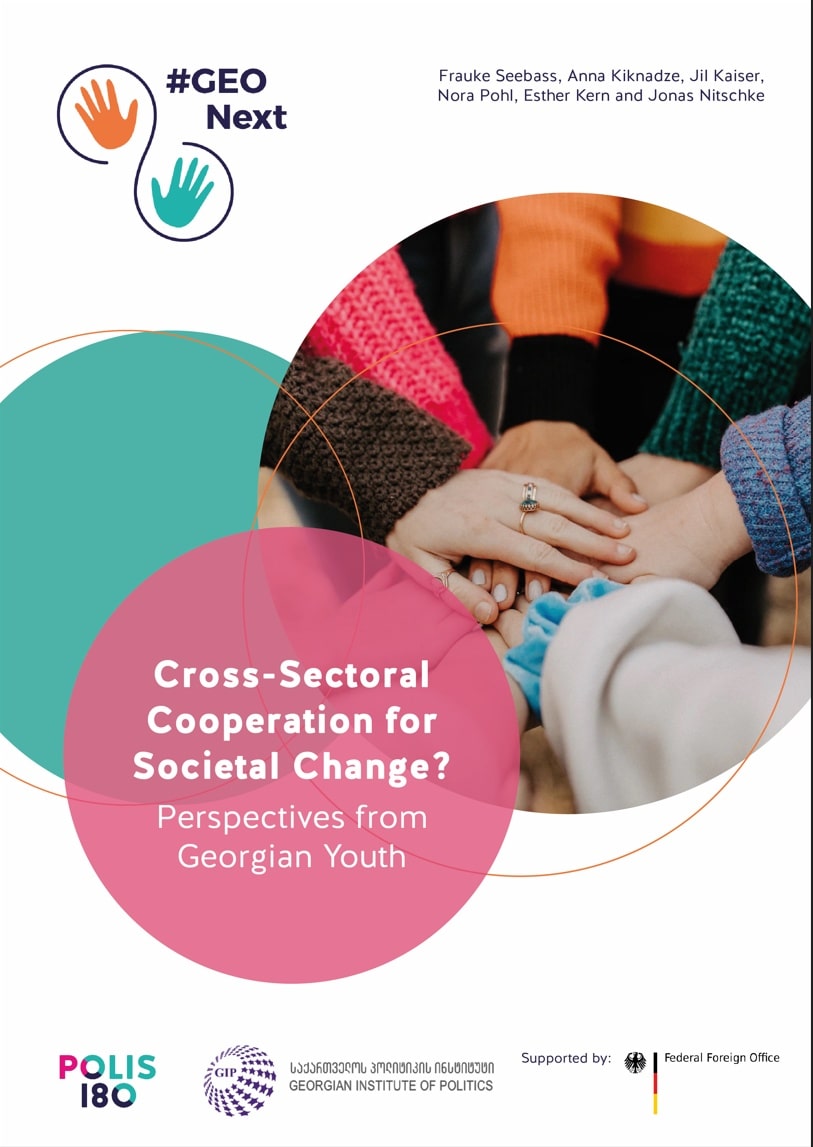
Cross-Sectoral Cooperation for Societal Change? Perspectives from Georgian Youth

Informed by international experts, research and practical experience in Georgia and Germany in the framework of #GEONext – Partnerships for Youth Engagement, this publication aims at providing a comprehensive perspective of the advantages and challenges of cross-sectoral cooperation, as well as best practice examples and tangible recommendations for successful collaborations across sectors.

Polis Paper N°16 | Refugees of Second Class: Ukrainian Roma in Hungary and Moldova

Since the Russian invasion of Ukraine, European leaders and civil society have shown an immense solidarity towards the people of Ukraine and in particular the refugees that were forced to flee to the neighbouring countries and the EU. However, this solidarity does not extend to Ukrainian Roma refugees, who face severe discrimination, segregation, and rejection. Moldova and Hungary are two of the most important transit countries for refugees on the way to Western Europe. As their authorities, government officials and civil society are publicly reinforcing harmful stereotypes about Roma, crossing the borders, asking for asylum, or accessing decent living conditions in refugee centres has become harder than ever.