
This blog is part of the series “David against Goliath: Lessons of Resistance from Eastern Europe and Central Asia” by the Perspektive Ost program at Polis180.
In January 2022, Kazakhstan faced its most violent domestic crisis since the end of the Soviet era. While the protests initially focused on rising fuel prices, they soon evolved into a broader rejection of authoritarianism.
The Kazakh phrase Qandy Qantar (Bloody January) is used by the Kazakh civil society and media to refer to the violent crackdown of those protests. The name signals the tragedy of the events, calls for justice, and emphasizes the ongoing demand that the victims must not be forgotten. Even though the protests seem to have been ignored by many in Europe, they have ongoing consequences for the civil society in Kazakhstan, because what followed was not reform – it was repression and a consolidation of power.
A blog post by Johanna Lutz
Historical Roots
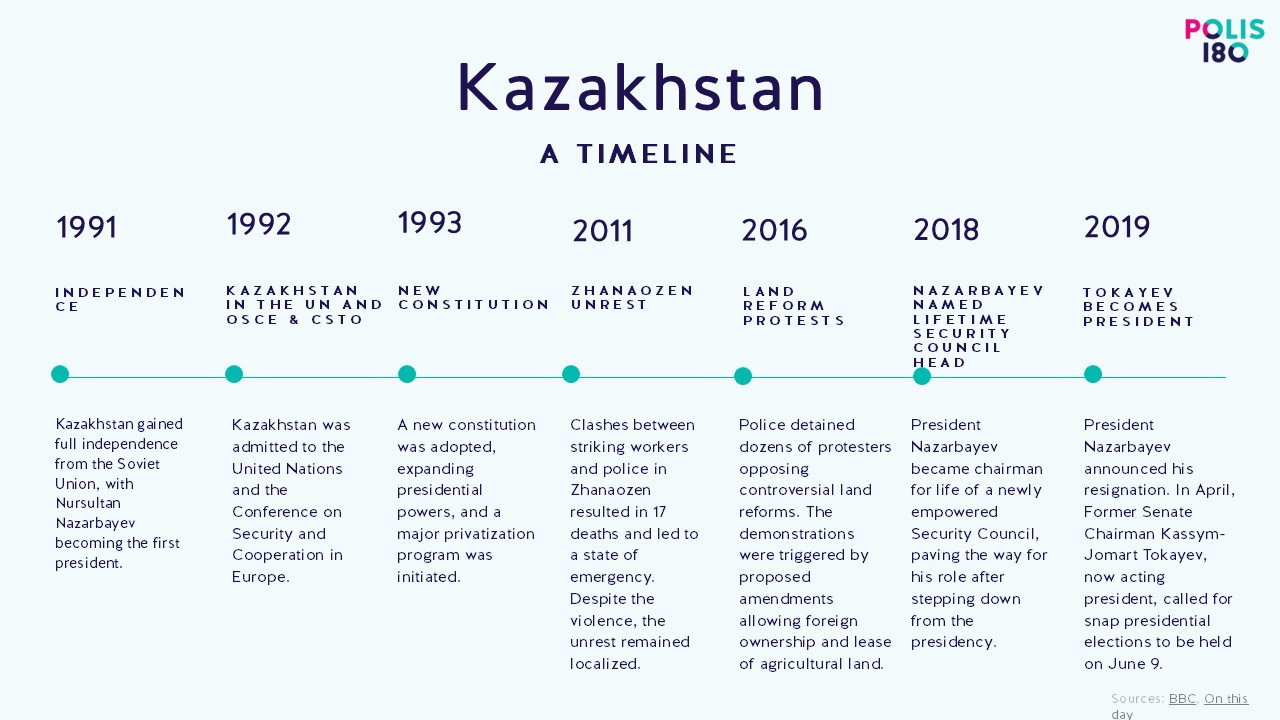
Since gaining independence in 1991, Kazakhstan has presented itself as a modernizing state with a strong economy first and a stable government second. On the one hand, the end of the Soviet Union enhanced the establishment of democratic institutions. On the other hand, the first President of the independent state, Nursultan Nazarbayev, concentrated power during decades of political repression, clientelism, corruption, and suppressing opposition. His successor, President Kassym-Jomart Tokayev, seemed to offer the prospect of political and economic reform. Nevertheless, measures such as the capital’s renaming from Astana to Nur-Sultan and the continued loyalty to Nazarbayev’s elite showed that the regime’s structure remained untouched.
January 2022 Protests: “Shal, ket!” (Old Man, Go Away!)
On January 2, 2022, protests against the sharp rise in gas prices started in the Western-Kazakh city of Zhanaozen. They spread throughout the country, with the largest demonstrations and most violent scenes taking place in Almaty. Despite President Tokayev’s quick announcement to lower gas prices, the protests continued, and the unrest revealed a deeper, long-simmering discontent with the status quo. The protests evolved into a broader rejection of authoritarianism and the demand for justice, transparency, a political voice, and above all, a discontinuation of Nazarbayev’s politics.
Although the protests were peaceful, they were met with disproportionate and brutal force. President Tokayev declared a state of emergency, the internet was shut down and communication blackouts prevented protestors and civil society from exercising external control and independent reporting – also allowing for abuses to take place in secret. On top of that, Tokayev ordered security forces to “shoot to kill without warning.” The use of live ammunition in densely populated areas was not only disproportionate, but also a violation of international human rights law. At least 238 people were killed, more than 10,000 were arrested, and countless others were injured. Many of those arrested were tortured or disappeared without explanation. Those targeted were often peaceful demonstrators or uninvolved citizens.
Rather than acknowledging the protesters’ demands, the Kazakh government criminalized them and labeled the unrest as a foreign terrorist plot and an existential threat to national sovereignty. Tokayev requested military assistance from the Collective Security Treaty Organization (CSTO), a Russian-led military alliance with Armenia, Belarus, Kazakhstan, Kyrgyzstan, and Tadjikistan. The fast collective intervention through sending troops via the CSTO and their violent suppression of the protests underscored Kazakhstan’s dependence on Russia, and how regime survival sometimes trumps national sovereignty. But the willingness to invite foreign troops to end domestic unrest also reflects a fear of internal legitimacy collapse.
A “New Kazakhstan”, or just a new claim?
The January 2022 events marked the government’s most significant challenge in Kazakhstan’s post-Soviet history. In the aftermath of the January protests, Tokayev introduced the slogan “New Kazakhstan”, claiming that the regime would take action towards political reform. However, critics argue that these reforms were largely symbolic: The cabinet resigned, in an attempt to calm down the demonstrations, and later on President Tokayev took over the chairmanship of the Security Council from former President Nazarbayev. The constitution was changed to limit presidential overreach, establish term limits, and strengthen local governance, in order to rebalance the power between executive and legislative, and to reduce privileges of Nazarbayev-era elites. Those were tools for Tokayev to legitimize his regime and consolidate power, rather than as a path to liberalization.
Comparing those announcements with the Realpolitik in Kazakhstan, there remains a gap. Human Rights Watch, Amnesty International and other observers have expressed deep skepticism and warned that torture allegations have not been properly examined, and that there has been no transparency regarding the security forces‘ use of deadly force. The European Parliament called for an international investigation and halting politically motivated charges as well as for the release of political prisoners (resolution 2022/2505(RSP)), but Kazakhstan’s leadership has refused all external inquiries. As of now, no high-ranking officials have been held accountable. Victims and their families continue to seek answers and justice.
Lessons from Qandy Qantar
Protests are one of a few ways for the Kazakh society to raise their voice and call for change, which is why the government’s violent response to the non-violent protests shocked many in Kazakhstan. Qandy Qantar was a turning point in the relationship between the citizens and their rulers. The protests showed that economic problems can easily escalate into broader political demands when governance fails to address social inequality and corruption. Tokayev’s silencing of alternative voices via internet blackouts and media suppression revealed how controlling narratives remains a central survival strategy for the Kazakh leadership. The government responded not with dialogue or reform, but with force, lies, and silence.
The European Union, despite adopting a resolution that condemned the violence and called for accountability, has done little beyond issuing statements. The EU’s reliance on Kazakhstan as a partner for energy and regional stability has limited its willingness to apply real pressure. This inconsistency risks undermining the EU’s credibility in Central Asia, where civil society actors look to Europe for solidarity but in fact see its geopolitical pragmatism prevail over principle. Meanwhile, Kazakhstan’s leadership has doubled down on repression, targeting independent NGOs, journalists, and activists. Especially the narratives of “foreign interference” are used to legitimize the suppression of dissent and the restriction of civic freedoms. Unless the EU and other international actors respond with more than symbolic criticism, they risk normalizing a dangerous regional trend: the silencing and violent crackdown of civil society under the argumentation for national sovereignty.
Johanna Lutz joined Polis in April 2025. She studies Peace and Conflict Studies in Osnabrück and is particularly interested in the South Caucasus and Central Asia.
Previously from the blog series “David against Goliath: Lessons of Resistance from Eastern Europe and Central Asia”
-
Let’s Start Looking East…and Listening to them, too!
-
The Fight for the Diaspora – About Grievances and National Identity in Romanian Elections
-
Georgia’s fight for EU: Protests against Russian interference
-
Are the Streets Enough? Lessons from Protests in Serbia and Georgia
-
Qandy Qantar – Bloody January and the silencing of a Nation
-
Ukraine’s Underground Resistance: The Unseen Battle for Sovereignty
The Polis Blog serves as a platform at the disposal of ‘Polis180’s & ‘OpenTTN‘s members. Published comments express solely the ‘authors’ opinions and shall not be confounded with the opinions of the editors or of Polis180.
Zurück