
Europe is entering a new nuclear era. As uncertainty over US security guarantees grows, France is extending its nuclear deterrence to European allies and is deepening cooperation with Germany. What does this mean for European security, and Russia’s strategic calculations? This article explores France’s new step forward, its implications for European strategic autonomy and the challenges that lie ahead.
A blog post by Adrian Eppel and Leonie Gruber
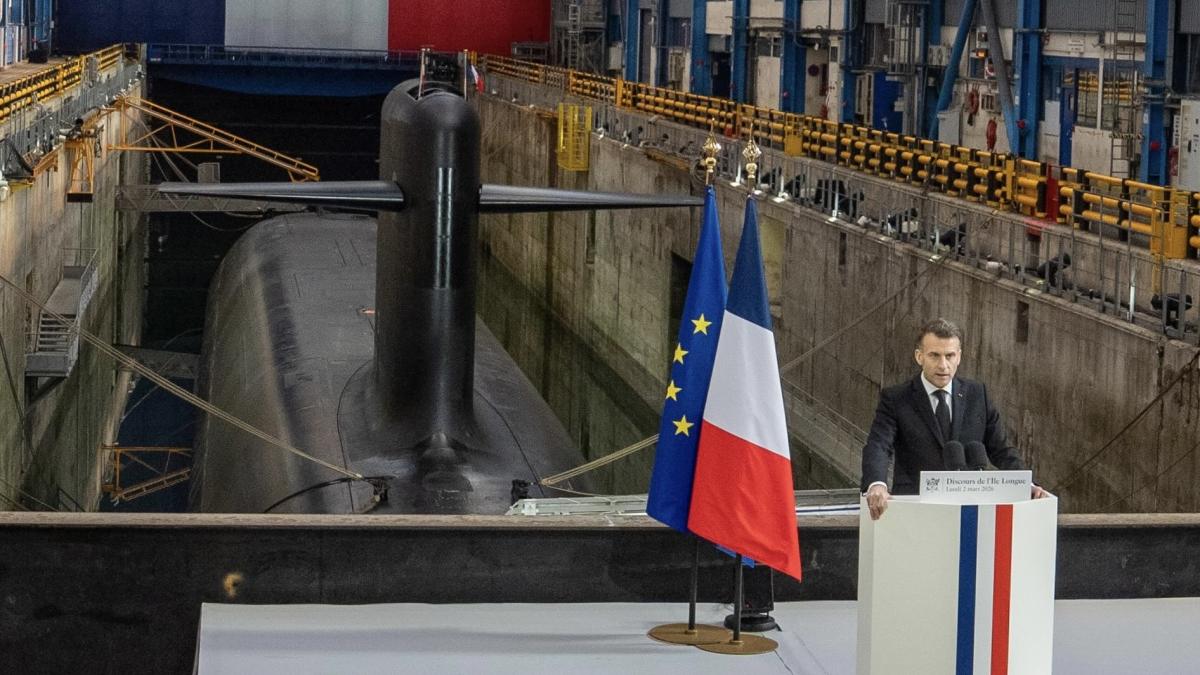
In early March this year, French President Emmanuel Macron presented an updated national nuclear doctrine at Île Longue, the operational base of France’s ballistic missile submarine fleet. The announcement outlined two key developments. First, France will expand the number of warheads in its nuclear arsenal, with specific figures remaining undisclosed for security reasons. Second, the doctrine introduces a stronger European dimension: Allied countries will be invited to participate in deterrence exercises, with the possibility of temporarily hosting strategic forces on French territory. Eight European partners have already agreed to engage in this framework, including Germany. Beyond these announcements that made the headlines around Europe, Emmanuel Macron also unveiled plans for a Franco-German nuclear steering group. “Forward deterrence”, that is what Macron calls his new nuclear doctrine.
What factors have driven these decisions, and what role will Germany play within the new framework? Finally, how has Europe’s aggressor, Russia, responded?
Uncertain Times Call for Extraordinary Measures
Since Macron’s last major address on nuclear issues in February 2020, the world has changed dramatically. For decades, Europe relied on the American nuclear umbrella as a cornerstone of its security architecture, a dependence that emerged in the aftermath of the Second World War as a response to the growing threat posed by the Soviet Union.
Although Washington maintains that the US nuclear umbrella remains firmly in place, today, that guarantee seems less certain, with Europe and the United States caught in a mounting credibility crisis driven by political unpredictability in Washington. Lack of credibility undermines deterrence: For Europe’s deterrence posture to remain credible, Russia must believe that the current US administration would commit all remaining US capabilities in case a NATO member gets attacked (NATO Article 5).
Against this backdrop, France, one of only two European nuclear powers, is moving forward with a new doctrine that could serve as a safeguard should Washington prove unwilling to support its NATO allies.
Franco-German Collaboration as a Product of Strategic Considerations
The fractures in the American umbrella represent a particular issue for Germany. Being constrained to international legal commitments such as the Non-Proliferation Treaty and the 2+4 Treaty, it is not allowed to build its own nuclear defence capabilities. Germany is, and will remain, dependent on other countries for nuclear deterrence; the key question is which country – or countries – will provide that deterrent.
Prior to 2022, Berlin had been highly cautious in the area of Franco-German nuclear cooperation, preferring to avoid any perception that it is turning away from the United States, its strongest partner within NATO. But since leadership in the USA has changed, and there is an urgent need to strengthen European sovereignty and strategic autonomy, Germany entering into deeper collaboration with France is a historic step.
What role exactly the Franco-German nuclear steering group and the collaborative deterrence exercises will play in the future, remains uncertain. Germany aims to avoid creating a competing structure to the NATO Nuclear Planning Group, or to to fully cutting ties with the US. That’s why bilateral cooperation with its strongest European nuclear partner seems to be the most feasible way forward for now. Franco-German nuclear collaboration followed Franco-British nuclear cooperation, signed under the Northwood declaration.
Against the backdrop of prior conflicts on military cooperation between France and Germany, such as FCAS, which has now failed due to disagreements on leadership and responsibilities, it is remarkable how fast Germany and France were able to come up with a joint declaration in this realm.
Reactions and Next Steps
President Macron’s announcement of the French extended nuclear umbrella has sparked nervous reactions in Moscow. Russian high officials called this move “an extremely destabilising development”. Kremlin spokesman Dmitry Peskov threatened to “take retaliatory measures” targeting France’s allies as a response. Whether this is mere rhetoric or not, it is clear that France’s new forward deterrence doctrine, especially when dispersed to allied territory, now needs to be part of Russia’s calculations, as pointed out by Jyri Lavikainen from the Finnish Institute of International Affairs.
Now, it’s important to make use of these new European bilateral structures while President Macron is still in power, in particular of the Franco-German nuclear steering group. A less pro-European successor in France might reverse or at least water down the French promise made at Île Longue. The prospect that Russian threats may materialise before the French umbrella is fully deployed, and while US protection remains uncertain, is alarming. However, it underlines the urgency of a swift implementation of the French nuclear deterrent together with its allies.
Leonie Gruber is a project officer in the division European Dialogue – Political Thinking on Europe at the Genshagen Foundation. She has a Master’s degree in International Relations and gained professional experience at the Franco-German Chamber of Foreign Trade and at the OECD in Paris. She is a member of the European Economic Policy Programme of Polis180.
Adrian Eppel works in civic education on EU and democracy issues and is a freelance lecturer for Introduction to European Law and European Studies at different universities. He holds a Master’s degree in International Relations. As a Polis180 member, he was a part of the editorial board of the journal PolisReflects.
Image via: French Ministry for Europe and Foreign Affairs
More from the European Security and Defence Policy Program
-
Under My French Umbrella: Rethinking Nuclear Deterrence in Europe
-
Europa unter Druck: Warum die neue US-Sicherheitsstrategie Europas Sicherheitsordnung neu gestaltet
-
Trump und die Ukraine: Können Deutschland und Europa im Falle eines Waffenstillstandes langfristige Stabilität sichern?
-
Boxers in the Baltics – The Case for “Mittlere Kräfte” in the Paradigm of Territorial Defence
The Polis Blog serves as a platform at the disposal of ‘Polis180’s & ‘OpenTTN‘s members. Published comments express solely the ‘authors’ opinions and shall not be confounded with the opinions of the editors or of Polis180.
Zurück