
This blog is part of the series “Shrinking Spaces – Creating Spaces” which is hosted by the (Un-)Making Democracy program at Polis180.
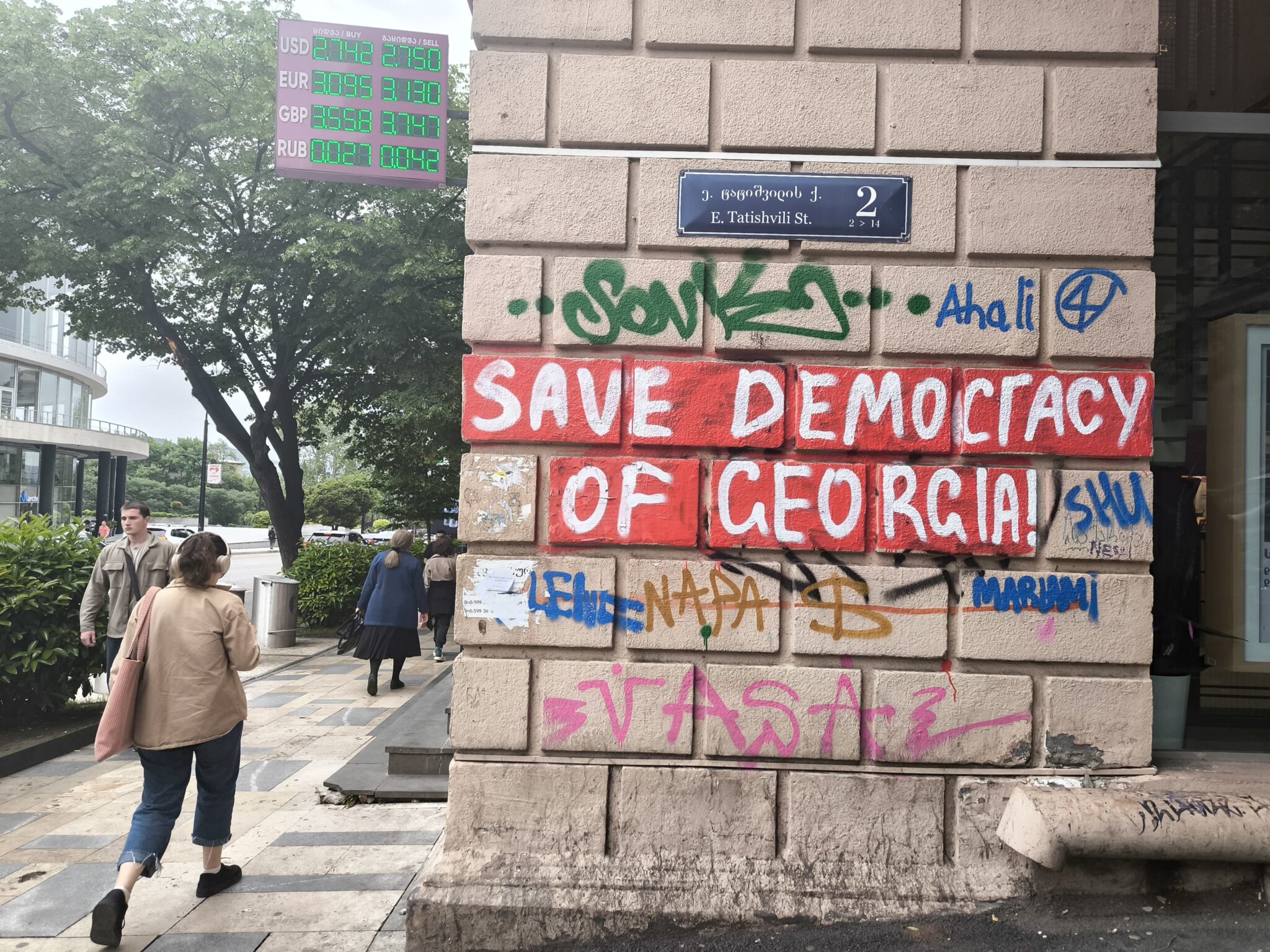
For a year, Georgia has been witnessing one of the most sustained waves of protest in its modern history. Since late November 2024, citizens have been taking to the streets every day to protest against rigged elections and authoritarian legislation, demanding a democratic future and a return to the country’s European path. The government has responded by tightening control even further. Despite this democratic crackdown and ongoing repression, Georgia’s civil society has developed new tactics and solidarities, along with creative forms of resistance.
A blog post by Johanna Lutz
For this blog post, I interviewed two young activists about their experiences. Mariam and Anastasia have been present at Rustaveli Avenue, the hotspot of the protests, nearly every day for the past months.
Georgia at Crossroads
The ruling Georgian Dream (GD) party has consolidated its power over the last years by tightening control of the judiciary, manipulating elections, and dominating media narratives. GD won the parliamentary election on 26th October 2024 with 54 % of the votes. However, opposition parties and observers reported massive irregularities, including vote-buying, multiple voting, identity fraud, and widespread manipulation. Whereas some protests occurred in the immediate aftermath of the election, the main turning point was the government’s decision to stop the EU accession talks, marking a turn toward Moscow and against the 74% of Georgians who support association with the EU. What changed in just months was not the will of Georgians, but the will of a government that has realigned itself with Moscow and dismantled democratic norms at unprecedented speed. The situation deteriorated further in April 2025, when the government passed a number of laws, including the Foreign Agents Registration Act, expanding legislation to target not only NGOs but also individuals. Anyone receiving foreign funding and engaging in public advocacy is required to register as a foreign agent, thus becoming subject to government monitoring and potential imprisonment for non-compliance.
“Over the past decade, civil society has played an important role in raising awareness about democracy and human rights. But now, the prestige of NGOs has shrunken because the government passed anti-NGO laws, leading people to believe that NGOs are against Georgia and work for foreign interests. This law doesn’t bring transparency. It brings fear. It tells society that we are traitors, not patriots.” – Anastasia
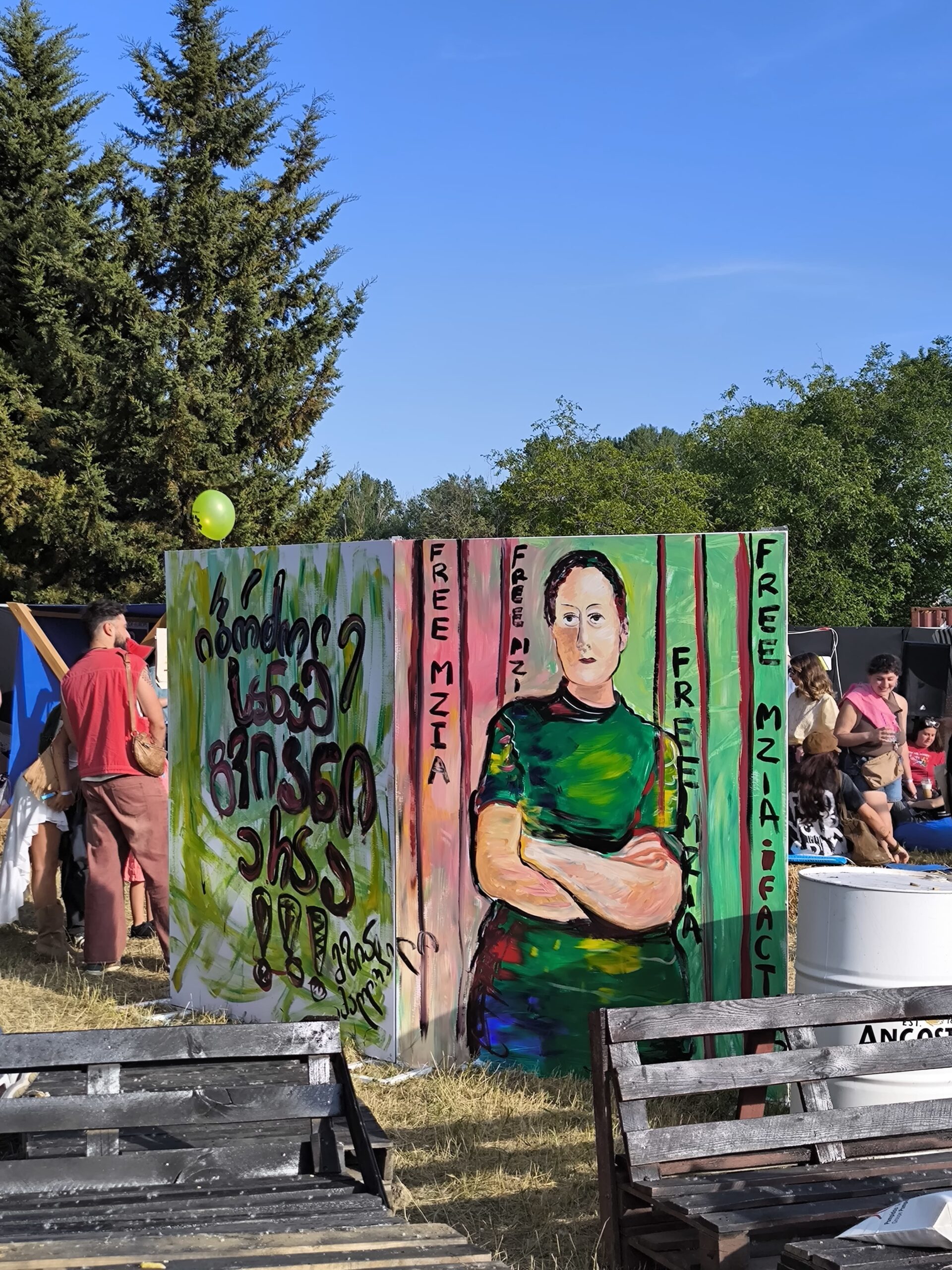
Independent media have come under increasing pressure as well. An example is the arrest of journalist Mzia Amaglobeli in spring 2025. Her case is a stark illustration of the erosion of civic space in Georgia and of the repressive measures increasingly used to silence critical voices. Her detention on disproportionate criminal charges reflects how the criminal justice system is being instrumentalised not to uphold justice, but to suppress journalists, activists, human rights defenders, and opposition figures, who challenge the government’s policies.
On 4th October 2025, Georgia held local elections in all 64 municipalities. Most opposition parties boycotted the vote, citing a repressive environment and concerns that their participation would only grant legitimacy to the ruling GD party. The elections were held without international observers and under the continued repression of the authorities. To protest the election, tens of thousands of people gathered in Tbilisi, where protesters built makeshift barricades and chanted “Freedom for the Imprisoned!”. In the aftermath, GD pushed through a series of legal changes, which led to a criminalisation of the protests by framing them as a threat to public order and sentencing unproportionally thereby eroding political pluralism at a shocking speed.
Resisting Repression – Expanding Courage
The ruling party met resistance with growing repression. Dozens of protestors, as well as all opposition leaders, are in jail or sentenced to charges – Georgia by now has more political prisoners per capita than Russia. Yet, paradoxically, the ongoing repression gave rise to new networks of solidarity and resistance. Over time, demonstrations evolved from chaotic confrontations into sustained, symbolic acts of occupation. Activists set up semi-permanent camps outside the national parliament, maintaining a continuous presence that turned public space into civic space. While overt violence was common in the beginning of the protest movement, repression has become increasingly bureaucratic and digital. Authorities use AI-driven video surveillance to identify protesters and levy crippling fines that have become a form of financial repression. Some refuse to pay the fines, while others collectively crowdfund them, framing solidarity as both resistance and survival.
“All people I know have been fined by the government, including me. We have turned it into an everyday duty. We are gonna keep protesting, we are gonna keep resisting, we are gonna keep coming to the protests until we see a change. The repressions didn’t stop us. Georgian people’s motivation grew as well.” – Anastasia
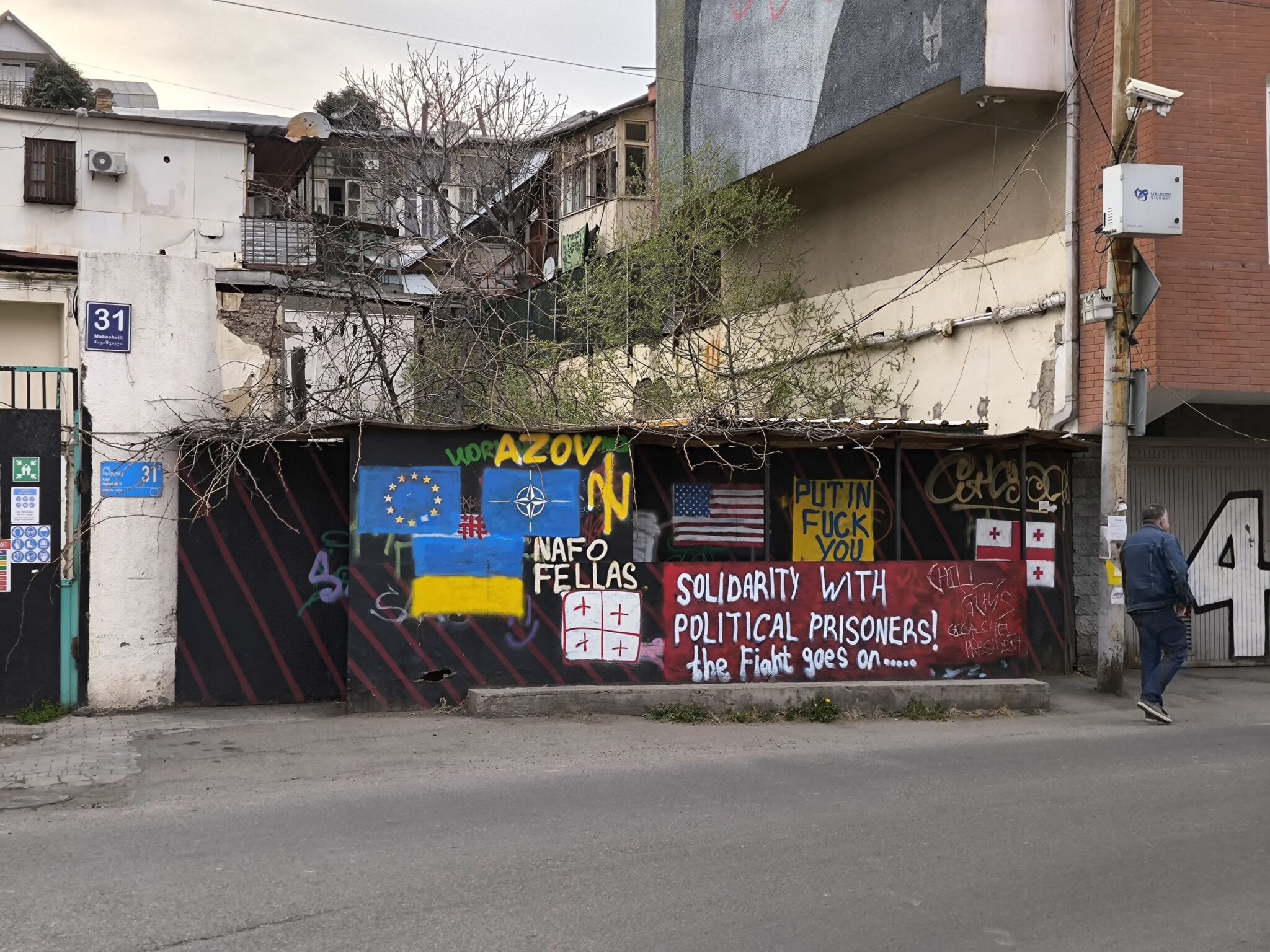
Now, the main demand of the protesters is the release of political prisoners. Among them are opposition leaders, journalists, and dozens of ordinary citizens detained for peaceful protest. Their imprisonment has become a rallying symbol for Georgia’s wider democratic crisis.
“My country chose many years ago that it wants to be part of Europe, and the fact that this government betrayed this decision of my people is unacceptable. That’s why every day we go on the street and stand up against this betrayal. However, at the moment, the most important thing is to support those who were imprisoned – they must be free! We will keep protesting. We will keep resisting. Until we see a change.” – Mariam
Between Courage and Collapse – Why Georgia’s fight is Europe’s fight
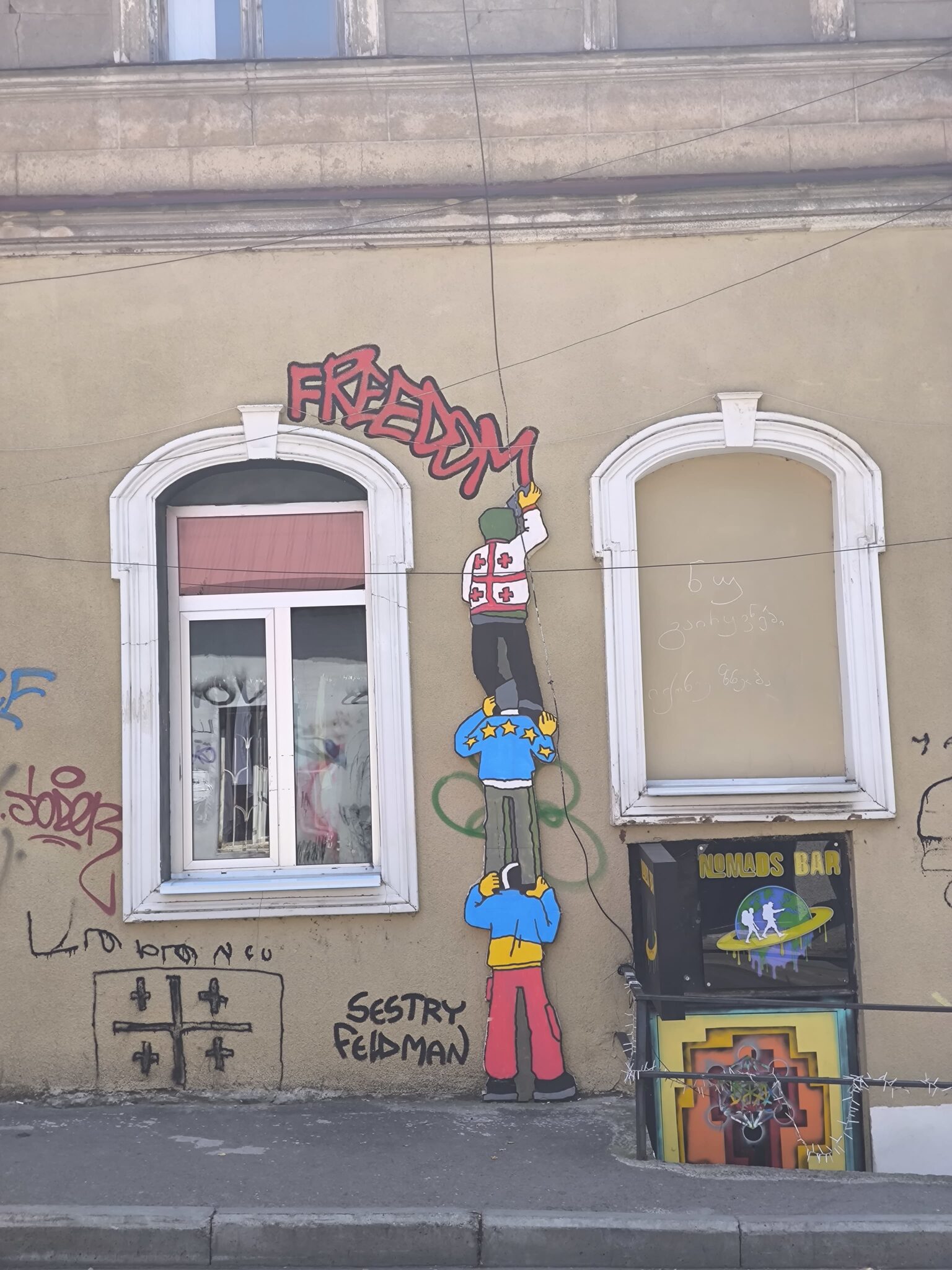
Georgia’s story is one of shrinking spaces and expanding courage. In the face of laws designed to silence them, citizens have built new forms of collective expression. Against surveillance, they have created communities of trust. Against despair, they have cultivated hope. If there is one message from Georgia to Europe, it is this: Democracy is not a gift bestowed by governments, but a practice defended by citizens.
Georgia’s struggle for democracy is exemplary for resistance under authoritarian pressure. Yet, the EU’s cautious response shows a lack of coherent vision for its eastern neighbourhood. Following the October 2025 municipal elections, the EU’s High Representative, Kaja Kallas, and Commissioner for Enlargement, Marta Kos, issued a statement urging “calm and restraint” and condemning disinformation targeting the EU. Now, the curtailment of democratic institutions and processes is not a new phenomenon. The recent developments in Georgia in the past few months mirror those in Russia and Belarus in many aspects, and require more sustained action by the EU. Sanctions against individual GD elites, increased funding for independent media and NGOs, and protection mechanisms for persecuted activists would signal a more principled stance. Protecting Georgian civil society is not charity. It is a test of Europe’s own democratic promise. Turning away would not only betray Georgia’s citizens. It would undermine the very democratic promise on which the European project is built.
Johanna Lutz joined Polis in April 2025. She studies Peace and Conflict Studies in Osnabrück and is particularly interested in the South Caucasus and Central Asia.
Previously from the blog series “Shrinking Spaces – Creating Spaces”
-
Blog Series: Creating Spaces – Shrinking Spaces
-
From Moscow with Laws: An Authoritarian Playbook of Rule by Law
-
Between Repression and Resilience: Georgia’s Fight for Democracy
-
Echo Chambers and Empty Streets: The Civic Cost of Disinformation
-
Space-Claiming as Contestation: The Feminist Movement ChalkBack and the Creation of Civic Space
-
How ICE infringes on social spaces and threatens democratic values
-
Beyond the Numbers: Visibility and the Politics of Gendered Violence
The Polis Blog serves as a platform at the disposal of ‘Polis180’s & ‘OpenTTN‘s members. Published comments express solely the ‘authors’ opinions and shall not be confounded with the opinions of the editors or of Polis180.
Zurück