
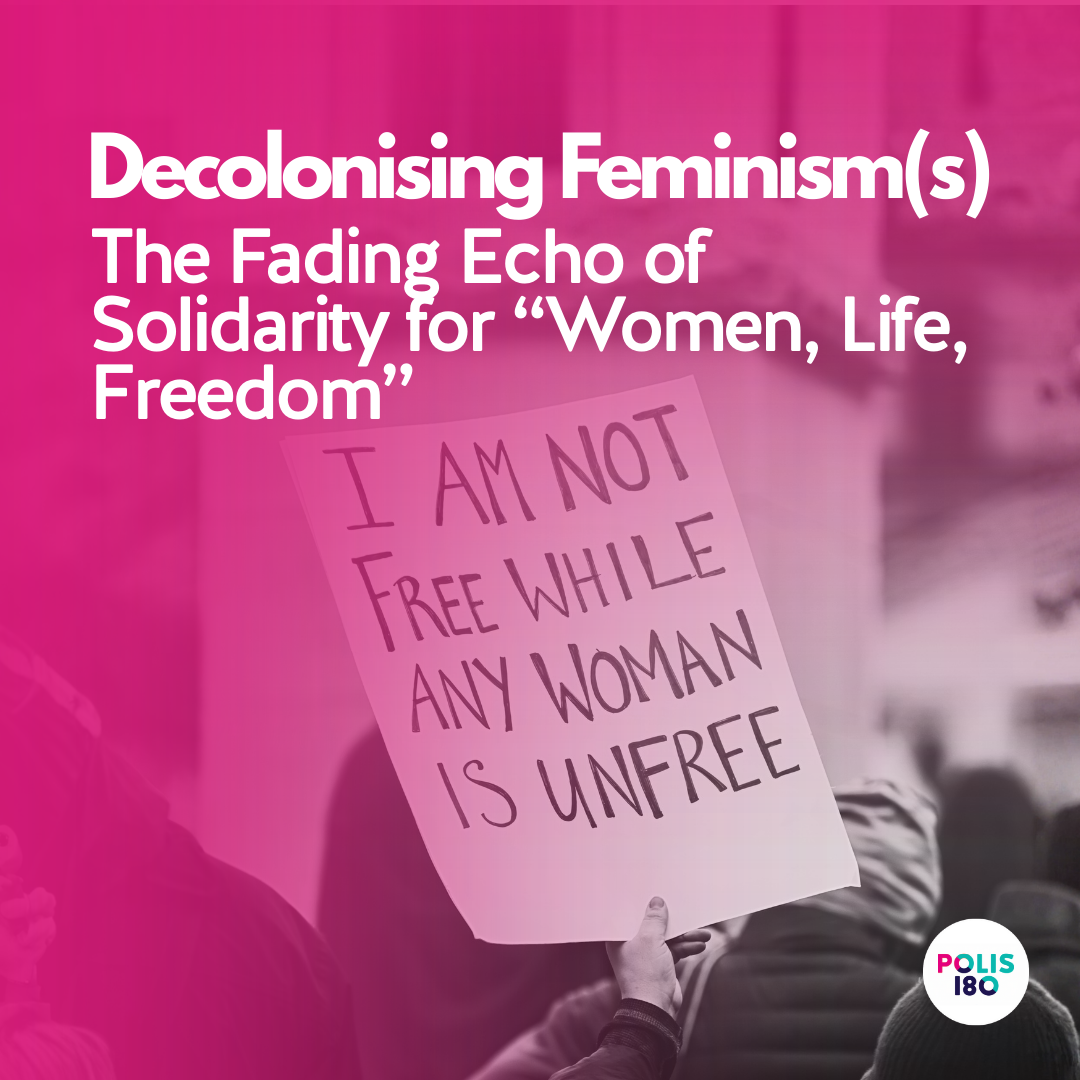
This blog is part of the series “Decolonising Feminism(s)”, hosted by the Gender & International Politics program at Polis180.
“Jin, Jiyan, Azadî.“ (Kurdish)
“Zan, Zendegī, Āzādī.“ (Persian)
“Women, Life, Freedom.“ (English)
We heard these slogans on the news, we saw them on social media, and we shouted them in the streets. The Women, Life, Freedom movement did not only erupt within Iran, but also sparked protests in Western countries such as Germany, Canada and France. Around the world, protesters had a clear goal: the fight for human rights, especially women*’s rights. But while their slogans were the same, the difference between the protests in Iran and those in the West could not be greater.
A blog post by Jule Bilger
The Shadow of State Violence in Iran
The collective anger shown in Iran in 2022 did not spark overnight. It is the long shadow of a brutal history of state repression dating back to Iran’s 1979 Islamic Revolution. In 2003 peaceful demonstrations arose against the upcoming privatization of universities, with students demanding freedom of speech, free education and democracy. In 2009 the “Green Movement” protested against President Ahmadinejad’s re-election. The demonstrators accused him of election fraud based on his unrealistic win, despite record voter turnout and pre-election polling predicting a much tighter race. In both cases, the forces of the regime under Ayatollah Khamenei reacted with the same cruel resolve: arrests, torture and brutal violence.
People were murdered in plain sight, like the protester Neda Agha-Soltan who participated in the “Green Movement”, got shot during a protest and bled to death on the streets. The demonstrations in 2003 and 2009 are merely two examples in an endless chronicle of civilian resistance in Iran, yet it is clearly visible that people are willing to risk everything for their freedoms and their rights.
The Women, Life, Freedom protests stand for the combination of multiple fights. It’s the fight against the oppression of women, the fight against corruption and poverty, it is against ethnic discrimination and the Islamic Republic. And even though it is not just about women’s rights in these protests, it is women leading the message of Women, Life, Freedom. However, while people in Iran are on the streets protesting, Western narratives that appear in mainstream media spread a moralistic view that focuses heavily on the symbolic act of unveiling the mandatory hijab and seem to miss half of the occurrences, tending to focus on the victimhood surrounding Iranian women. And while Iranian protests get louder and they continue to face deadly repression for protesting, the question remains: How much longer can the West afford to look away? How much longer can we neglect and deny Iranian women*’s agency and why do we not want to look beyond our own feminist movements?
Amini’s Murder and the State’s Lie
For a short time, it appeared as though we finally were finally paying attention (spoiler: this attention was short-lived). It was the moment of the Women, Life, Freedom movement which gained immense western attention after the murder of the Kurdish woman Mahsa Amini on September 16th, 2022. Three days prior to her death Amini had been arrested in Tehran by the Guidance Patrol (also known as the morality police) for not wearing her Hijab properly. While being detained by the Guidance Patrol, Amini subsequently fell into a coma due to her previous illness, according to the Guidance Patrol, and three days later died of a heart attack. The regime’s official narrative is a cold and proven lie, whereas the truth is clear and undeniable: Amini’s parents strongly dispute the existence of any prior illness. Eyewitness accounts, gathered by groups such as the Iranian feminist organization „Women, Resistance, Freedom,“ suggest state agents severely brutalized Amini inside the police vehicle and at the station. Her death had nothing to do with an alleged illness; it was a deliberate murder triggered by a patriarchal, theocratic system.
The Courage
Amini’s death sparked a huge outbreak within Iran, it was indeed the straw that broke the camel’s back. While the Women, Life, Freedom movement was not new, this momentum sparked outrage beyond the already resisting women*.The Collective Action of Independent Iranian Women describes the uprising as “born from the fury and suffering of millions of women and men who have lived for years under the shadow of repression, discrimination, poverty and injustice” (Collective Action of Independent Iranian Women). A remarkable symbol of the movement were a group of women* who removed their headscarves as a rebellious act against suppression and paternalism (something which quickly got caught up by Western media). They screamed “Jin, Jiyan, Azadî“, “Zan, Zendegī, Āzādī“ and “Women, Life, Freedom“. The slogan is rooted in the Kurdish independence movement and probably appeared the first time after the arrest of Kurdish independence leaders in 1998, who prioritized women’s rights as part of their movement for Kurdish independence.
The people’s presence at the protests were fearless: many, like the 16 year old Nika Shakarami or Siavash Mahmoudi, were arrested, kidnapped and even killed. The list of people who died during these protests because of direct state violence, or their consequences, is unprecedentedly high.
It has to be acknowledged that the resistance movement is not only characterized by bravery, but also creativity. Having been denied the right to protest by the regime, Iranians carved out their own space to be heard. Women*, young people and other demonstrators organized the protests spontaneously via social media to prevent the morality police from intervening. This movement is different from the previous ones; this movement is unique. It was massive, it was brave, it was creative. And it brought together everyone. Women, Life, Freedom was led by women* and interconnected with other oppressed social groups, nationalities and ethnicities such as people from Kurdistan, Baluchistan, from Khuzestan or Azerbaijan. There was not one particular age group, one ethnicity, one gender fighting for justice, it was society as a whole. The movement “[…] infused new values into the broader Iranian struggle” as described by the Collective Action of Independent Iranian Women.
Getting inspired by the solidarity, unity and bravery among Iranian women*, there is an intuitive comparison to the protests in Western societies coming up where one may ask why is it that our feminist movements in the West often seem so scattered in themselves. Do we lose sight of the big picture, fighting together for equal rights, because we are too comfortable, too focused on identity politics to recognize a common goal? Perhaps what we witness in Iran reminds us that movements gain strength when the urgency is shared and the threat is collective. Maybe this is also why the protests in 2022 drew such intense attention at first. Unfortunately, that attention faded far too quickly.
The Fading Echo
Following the outbreak of protests in 2022, Western media became fixated on the protests and, for a time, enjoyed writing and posting about them. While it is both appropriate and crucial to pay attention, looking into the actual articles published and pictures posted, it is not only pure support that is visible. One must question the astonishment upheld by many papers, which appeared to frame the agency and independent organization of Iranian women as an unexpected phenomenon, reinforcing racist and colonialist notions of Western origin. Moreover, the attention directed toward these women was clearly not without ulterior motives. In fact, the attention they received neatly surrounded and often exclusively focused on the symbolic unveiling of Iranian women* during the protests. While it is true that many women unveiled as a symbol, it is also true that many did not. Crucially, the movement’s demand was never merely about the veil itself; the protests demanded rights, freedom and the power of choosing an independent life. But why all the confusion? Why the deliberate misunderstanding? It is the prejudices Western societies hold against women* wearing a headscarf that unfortunately makes the discourse about the Women, Life, Freedom movement also a discourse about Islamophobia.
It is all the more deplorable that, despite the escalation of violence by the regime against the protesters, the movement has mostly lost the attention of the international audience. Celebrities and public figures, like publicly declared their solidarity in October 2022, momentarily elevating the protest to the global stage. Yet, just as quickly as the trending hashtags appeared, they vanished. What happened?
In Iran, the fight is not over though. In fact, the situation for Iranians got even worse after the 12-day war between Israel and Iran in June 2025 and Trump’s attack on Iran, legitimizing it with the colonial, racist and sexist argument of “saving these poor women”. While the Women, Life, Freedom slogan still echoes through the streets and classrooms of Iran, it feels as though Western publicity has forgotten about the values they “supported so much” three years ago, which makes it questionable morality wise. Or have they? Have they ever believed in women*s freedom of choice? Or was the support not only driven by wanting to empower Iranians but also by Islamophobic prejudice and an opportunistic motive to pass anti headscarve legislation? When looking at current Austrian legislation debates these questions receive new and heightened relevance. It seems that the same people who declared solidarity with Iranian women* back then are now passing suppressive bills on the other side of the spectrum. Are we really expected to believe that switching from forced veiling to forced unveiling will bring freedom to any women*?
The Uncomfortable Question for Us
What remains at the end is not only a feeling of anger and shame looking back at the fading attention. There is also confusion about what happened to the solidarity with Iranians, which felt more like a fashionable trend than an actual commitment. The strength and volume of the Iranian resistance never wavered, but the will of Western media and mainstream political voices to sustain that public attention, failed. This is even more frustrating since there are so many things we could learn from the Women, Life, Freedom protests and their protesters. It is the bravery, the creativity and the risk they are willing to take we could all learn from. The greatness of this fight is a template for us to question our own ones and to think about the question why so few people in Western societies are fighting for human and women* rights, when the risk of demonstration is so low.
Ultimately, the West’s selective, Islamophobic lens reduced an existential call for fundamental rights into a mere visual/superficial trend, ensuring it never truly took into account the movement’s immense courage or its challenge to global inaction. The fearless unity witnessed in Iran holds a mirror up to our comfortable activism and the reflection it casts back is shattering and deeply uncomfortable.
Jule Bilger (she/her) joined Polis180 in 2025 and is part of the blog series “Decolonizing Feminism(s)”. She holds a Bachelor degree in sociology and political science and is currently taking an internship in Italy as an International Management Assistant for projects funded by the European Commission. As a legal advisor for asylum and residence law, her focus is on migration and international relations.
Previously from the blog series “Decolonising Feminism(s)”
The Polis Blog serves as a platform at the disposal of ‘Polis180’s & ‘OpenTTN‘s members. Published comments express solely the ‘authors’ opinions and shall not be confounded with the opinions of the editors or of Polis180.
Zurück