
This blog is part of the series “Shrinking Spaces – Creating Spaces” which is hosted by the (Un-)Making Democracy program at Polis180.
It is Tuesday, 2 June 2026, 2.15 pm. Hundreds of students gather in a medium-sized lecture hall at the University of Vienna, while many more remain outside, hoping to find a place inside still. They are angry, frustrated and determined. As the largest university in the German-speaking world refuses to engage with students‘ political demands, they have begun creating new spaces to speak, organise, and act in solidarity. This is the first official student assembly in the University of Vienna’s history, and the first of its kind in Austria. The agenda ranges from solidarity with Palestine, anti-militarism and anti-racism to university budget cuts. But how did we arrive here? Why do students feel compelled to create new spaces for political participation and collective action, spaces that have not been claimed in over 660 years of the university’s history?
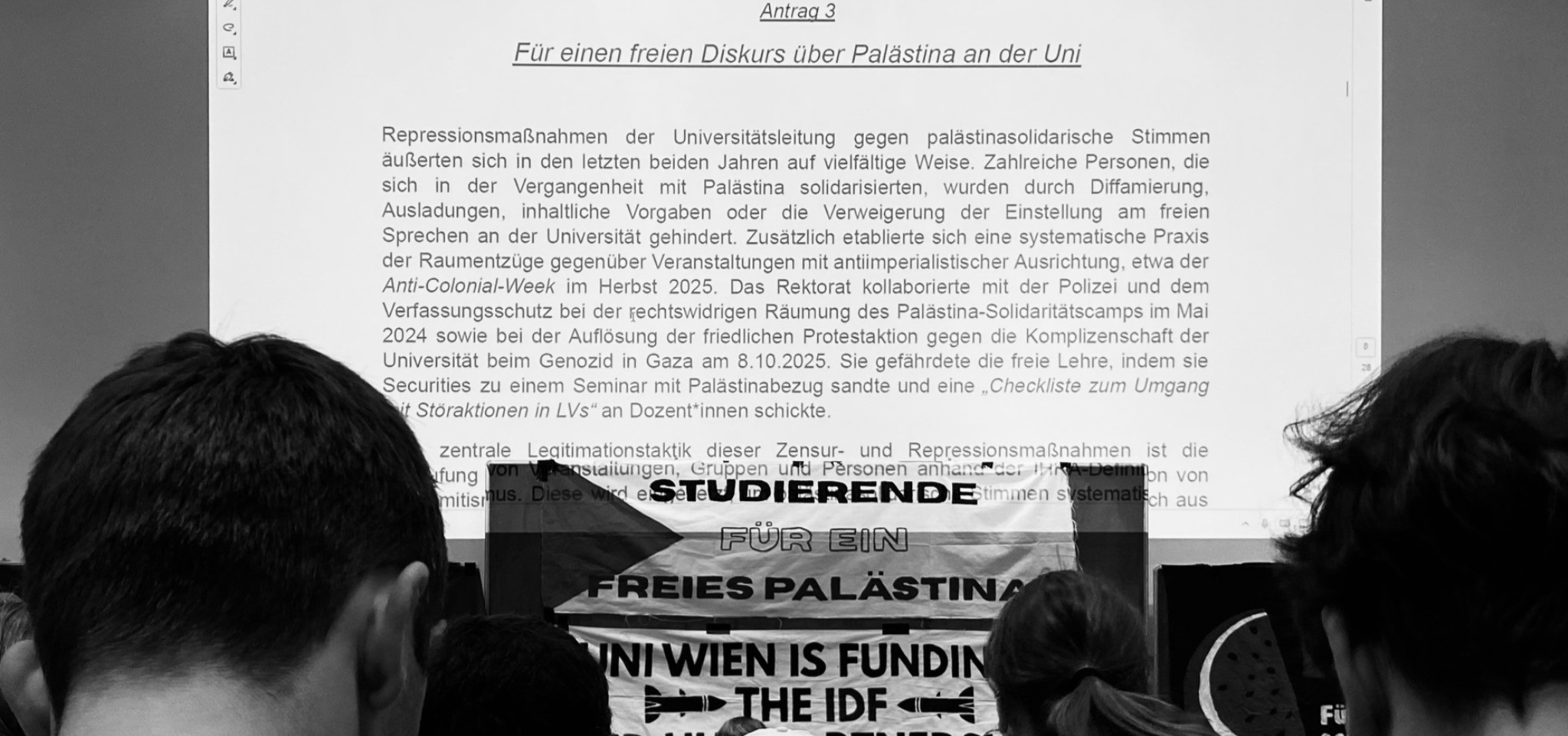
Pictures by the author (June 02, 2026): A lecture hall in Vienna
A blog post by Melissa Amann
Most of us know the phrases too well: Unfortunately, the seminar cannot take place. There is no funding this semester. Room capacities are limited. There are scheduling conflicts. Our hands are tied. Perhaps next year – yet there rarely is a next year. Events quietly disappear from the calendar, and the reasoning is rarely politics or censorship, but usually timing, appropriateness, or institutional fit.
While they may seem administrative, these explanations have political consequences all the same. Across European universities, increased security measures, vague regulations and administrative uncertainty have created environments in which dissent is increasingly risky. Under such conditions, political participation narrows. When the boundaries of academic discourse remain unclear, people learn to regulate themselves. Amnesty International has described such dynamics as a „chilling effect„, a phenomenon that threatens democratic participation itself.
Shrinking civic space is often imagined as something that occurs elsewhere, under openly authoritarian regimes. Yet, as students in Vienna have learned, civic space can also contract through administrative procedures and institutional language rather than overt repression. In autumn 2025, teaching staff at the University of Vienna received an internal checklist advising them on how to respond to protests and other forms of classroom „disruption“. Presented as a tool for upholding safety and order, it normalised the involvement of security personnel, including police intervention, while leaving many categories of unacceptable conduct deliberately undefined. The result was not clarity but uncertainty, encouraging pre-emptive caution and self-censorship.
And yet, this uncertainty does not appear to be entirely random. Looking closely at which events lose funding or which rooms suddenly become unavailable, one subject appears with striking regularity: Palestine. At the university, this means that while academic freedom may survive on paper, its exercise becomes increasingly conditional in practice.
Beyond Vienna
However, Vienna is hardly an isolated case. Since October 2023, universities all over Europe and North America have become central arenas of protest over Israel’s genocidal war on Palestinians, questions of international law, and Western political complicity. At the same time, human rights organisations have documented a widening array of administrative, legal, and police measures directed at Palestine solidarity protests, particularly on campuses. These developments reveal a broader pattern in how liberal-democratic states increasingly treat such dissent as a matter of order and security. While combating antisemitism remains essential and non-negotiable, scholars and rights groups have warned that expansive or politicised applications of frameworks such as the IHRA definition can blur distinctions between antisemitism, anti-Zionism, and criticism of Israeli government policy, with chilling effects on public debate and academic speech.
In October 2024, the UN Special Rapporteur on freedom of assembly and association urged universities to halt repressive responses targeting pro-Palestine solidarity protests, warning of wider threats to democratic institutions. In Austria, Amnesty International similarly documented restrictions at the University of Vienna, including the policing of protest on campus, most notably the Palestine Solidarity Encampment in May 2024, and reported pressures in academic hiring processes affecting candidates associated with boycott advocacy.
Whether in Vienna, Berlin, Paris, Brussels, Amsterdam, London or Lausanne, the cases repeat themselves, even if the intensity and form of restriction vary considerably by national and institutional context. There are also positive examples: when students at Trinity College Dublin set up an encampment in May 2024, the university chose negotiation over removal and later agreed to divest from companies operating in the occupied Palestinian territories. The response to Palestine solidarity was therefore a matter of choice rather than necessity. While the University of Vienna presents its actions as unavoidable, Trinity College Dublin shows that a different course is possible.
A pattern emerges in which universities increasingly frame political dissent as a risk to be contained rather than a condition of critical inquiry. This narrowing goes beyond university into civic spaces, shaping who can participate in public and political life and under what conditions. Amnesty International’s assessment concludes that measures adopted by European governments in response to peaceful expressions of solidarity with Palestine regularly fall short of basic human rights standards and risk reinforcing patterns of racialisation that disproportionately affect Arabs, Muslims, and Palestinians. If anything, solidarity with Palestine has become a stress test for how much dissent liberal democracies actually tolerate, with increasingly clear results.
The Self-Image of the Liberated University
Historically, universities have functioned as epicentres of system-critique and emancipatory change. Across the global majority, they were also central to independence movements, postcolonial state formation, and radical intellectual life. Even though European universities continue to imagine themselves as spaces of free inquiry and democratic contestation, this self-image has always been more flattering than accurate. Academic freedom has never been evenly distributed, and universities have always been more receptive to certain forms of critique than to others. Palestinian perspectives, like many other subaltern and racialised voices, have frequently been cast as suspect or overly partisan, shaped by entrenched power asymmetries and selective appeals of historical responsibility. Thus, universities have never simply hosted democracy. They have negotiated, rationed, and, at times, withheld it from those whose speech unsettled institutional comfort or political alignments.
It is therefore worth asking whether public spaces are in fact shrinking, or whether we are only now recognising the limits that have long structured them? Put differently: are we witnessing genuinely new forms of repression, or is a historically privileged academic mainstream only now encountering constraints that have long shaped the conditions of participation for others? What appears as a shrinking public space may, in this sense, be partly a crisis of visibility rather than a sudden rupture. For much of the past, the selective distribution of academic freedom could remain largely unmarked precisely because it disproportionately affected those already positioned at the margins, those labelled “controversial”, racialised, or politically expendable. If we are to face up to this unsettling reality, we must resist reducing the latest occurrences to either a simple narrative of institutional collapse or one of delayed perception alone. Instead, we should recognise that what produces today’s discomfort is precisely the convergence of historically embedded restrictions which in certain respects are newly felt.
Order as the Strategy of Choice
Amid these debates, the question of shrinking space cannot be separated from the structural conditions within which the universities are set. Neoliberal reforms, embodied in the Bologna process, austerity politics, and the logic of permanent competition, have transformed European universities from public institutions into managed organisations in recent decades. And with it, this shift has not merely redefined governance but the university’s very function. Far from operating as neutral spaces of inquiry, universities increasingly depend on state-funds as well as, and even more so, on their reputation, tied to external funding and public perception. In this regard, conflicts, and especially those potentially harming the reputation, become costly. Thus, stability, in turn, becomes a governing principle.
This logic is most visible in anticipatory forms of governance, where potential controversy is managed before it unfolds. The 2023 cancellation of the teach-in series Against the Present: Past and Future Perspectives on Palestine at the University of Vienna illustrates this dynamic vividly. Although formally justified in terms of balance and representation, the decision to cancel followed rapid political pressure from within the governing coalition. Direct causality seems almost impossible to prove, however, a pattern of pre-emptive containment is evident. In recent years, this tendency has been particularly evident in relation to Palestine solidarity and critical discourse, including heightened scrutiny of public events and speakers such as Francesca Albanese or Rashid Khalidi. In this context, policing and securitisation appear less as exceptional responses but more as routine instruments of institutional self-preservation. The imperative to manage risk and secure the institution’s reputation and financial flows starts to outweigh the obligation to foster critical thinking, narrowing the space for academic contestation. Dynamics which are likely to intensify further in Austria, where proposed cuts of around 14% to public universities have already triggered mass protests, highlighting growing tensions. Edward Said, a Palestinian who spent his life caught between exile and the academic establishment, saw this shift as a betrayal of the intellectual’s role. He describes how critical thinking proves its worth precisely when it comes at a cost, rather than when it has no consequences. A university no longer willing to pay that price then ceases to be the very institution it claims to be.
Shrinking Space at the Heart of Europe
What this says about Europe is unsettling: shrinking spaces are no longer only a problem at the margins of democracy, but increasingly at its very core. When universities begin to manage dissent as a security risk rather than defend it as part of democratic and intellectual life, Europe’s liberal self-image starts to ring hollow. When even universities unlearn how to embrace and live with dissent, shrinking spaces are no longer an exception but become a governing logic. All the events mentioned in this essay, and many more, are therefore not just local occurrences, but a trend we see all over European and North American universities. This essay thus highlights that if European countries and their universities still want to speak the language of liberalism and critical thought, they must stop disciplining dissent the moment it becomes inconvenient. Otherwise, they may soon find that defending their institutions comes at the expense of their very democratic purpose.
Notes: The „Checklist: Dealing with protests or other disruptions during courses“ is an internal document by the University of Vienna, and is thus not available to the public. However, teaching staff later issued an open letter publicly and sent it to the head of administration.
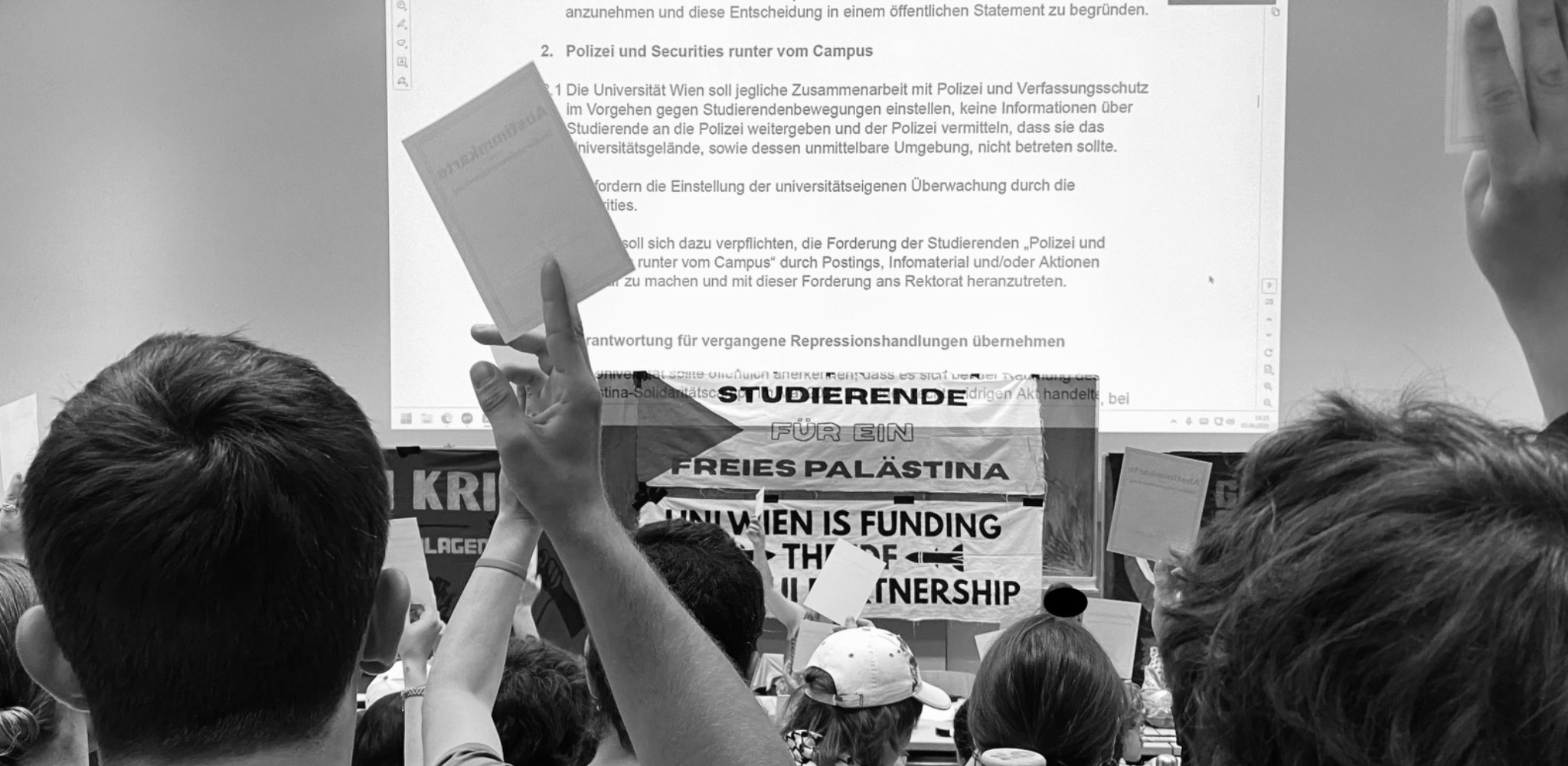
Pictures by the author (June 02, 2026): A lecture hall in Vienna
Melissa Amann (she/her) joined Polis180 in 2024 and is Co-Lead of the Program “Gender & International Politics” as well as the blog series “Decolonising Feminism(s)”. She studied Public Governance across Borders in Germany, the Netherlands and Spain, and is currently pursuing her master’s in Development Studies in Austria. Her research interests focus on the intersections of gender, governance, and the digital public spheres.
The Polis Blog serves as a platform at the disposal of ‘Polis180’s & ‘OpenTTN‘s members. Published comments express solely the ‘authors’ opinions and shall not be confounded with the opinions of the editors or of Polis180.
Zurück