
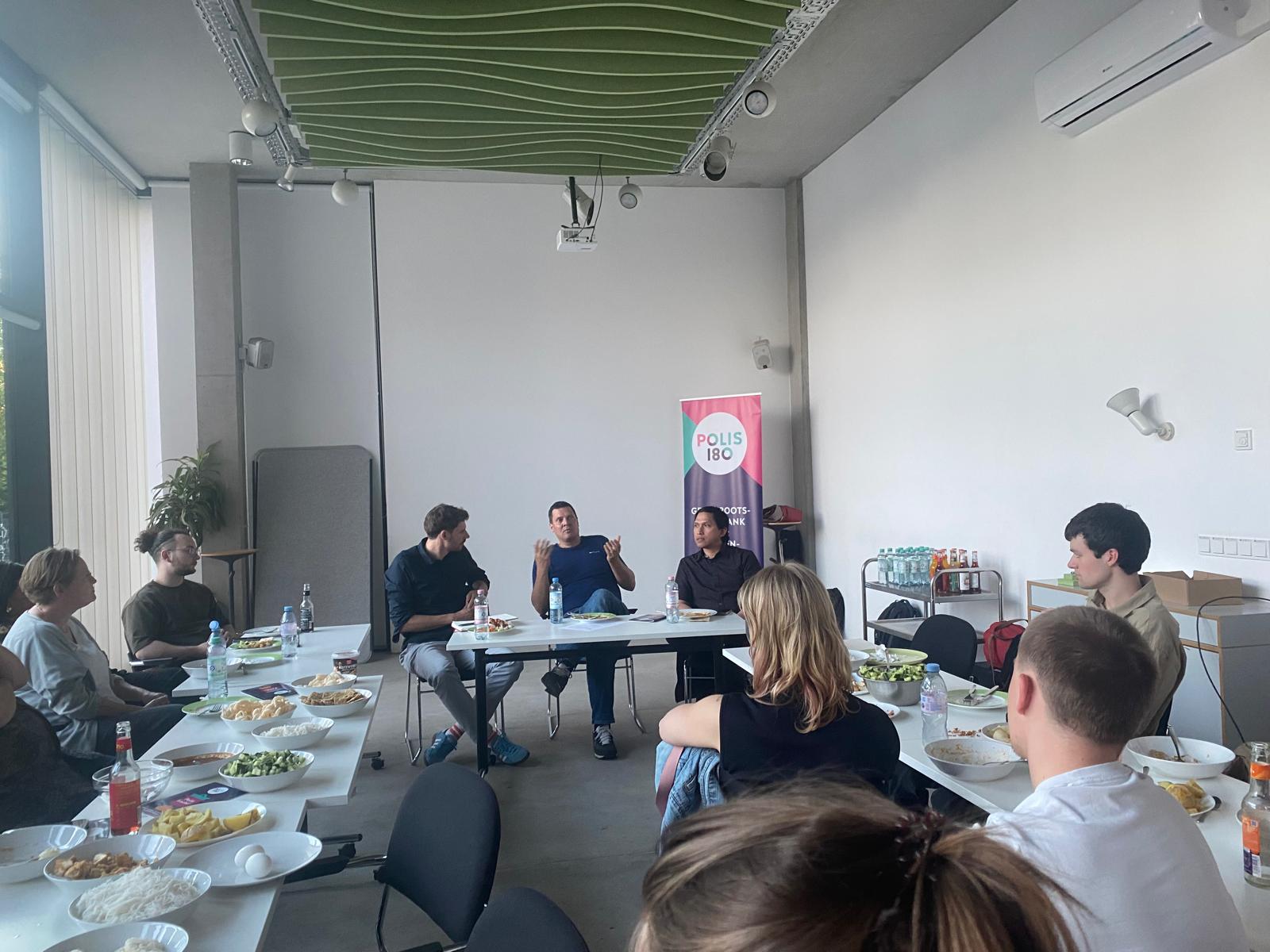
This blog post is an event report and forms part of the event series “Polis kocht!”, which is organised by Polis180 with the support of the Berlin State Agency for Political Education.
Germany and Indonesia are two middle powers navigating an international order shaped by great-power rivalry, shifting alliances, and new trade dependencies. To better understand the evolving German-Indonesian partnership and the role of youth in shaping middle-power cooperation, Polis180, supported by IndoHub, organised a „Polis kocht.“
On 8th of July, around 20 young people with an interest in foreign policy, from Germany and Indonesia, came together at Berlin Global Village to discuss, together with Dr. Felix Heiduk (Stiftung Wissenschaft und Politik, SWP) and Dr. Abdil Mughis Mudhoffir (GIGA Institute for Asian Studies), the state and future of the German-Indonesian partnership.
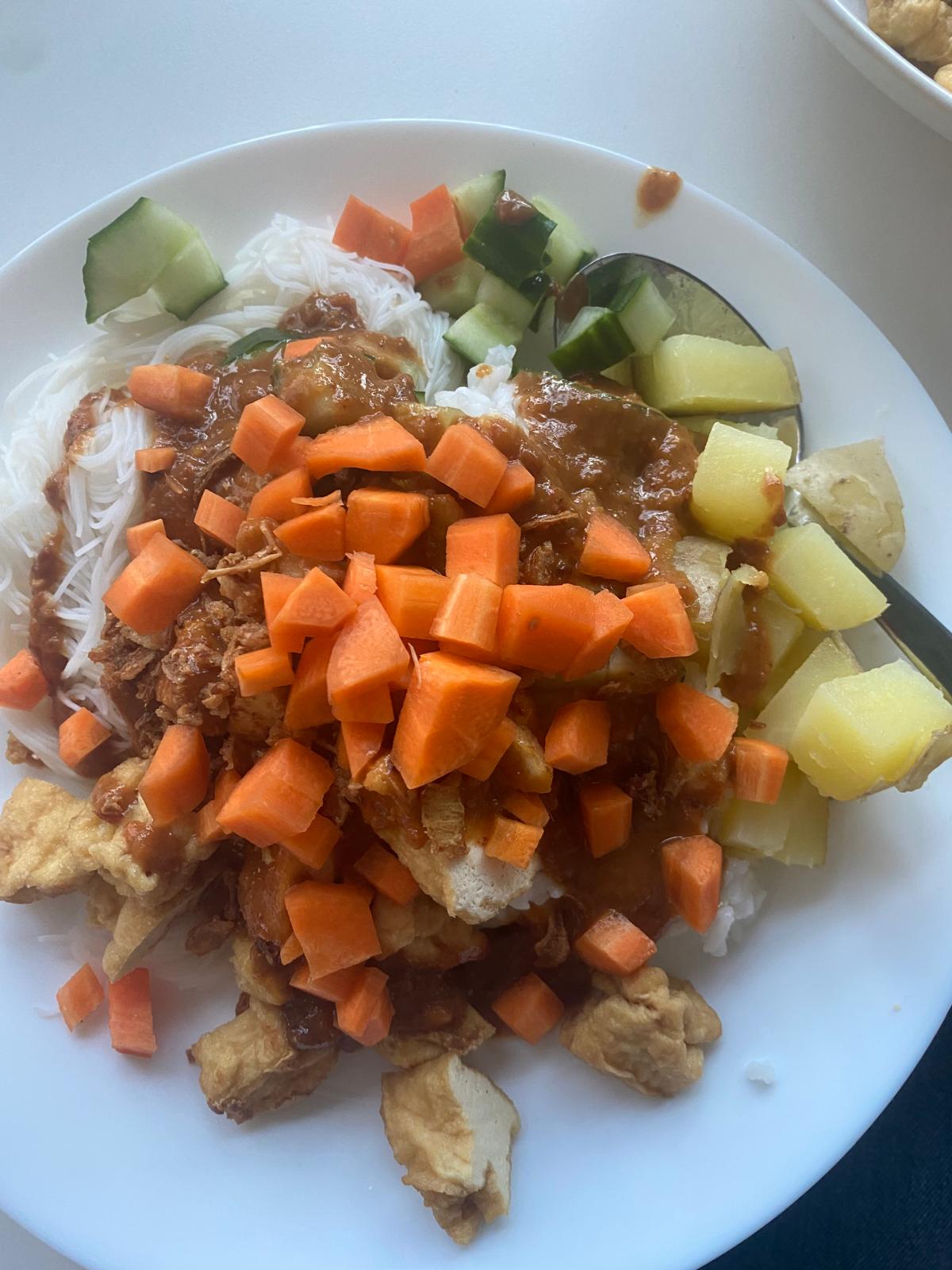
Henrik Hansen, a longtime member of Polis180, opened the evening with a short introduction to Polis180 and IndoHub. Then the participants started preparing Ketoprak, a traditional Indonesian dish made of tofu, vegetables, rice, rice noodles, and a rich peanut sauce. While preparing the food, the first discussion started about the evolution of the German-Indonesian partnership, its possible future development, and what role the youth can take in it.
Middle Powers and Indo-German Relations
The reelection of Trump, Russia’s war of aggression against Ukraine, the wars in the Middle East, and China’s changing role in global politics have upended traditional frameworks for international cooperation. The many countries lacking global superpower status, such as Germany and Indonesia, have to adjust to the new realities of international politics and need to diversify their partnerships.
Amid these changes, Indonesia and Germany are exploring avenues to cooperate on a wide range of topics. The energy transition and environmental protection are one common topic; trade is another, especially since the new EU-Indonesia trade agreement. Building on the ideas put forth in Mark Carney’s „Middle Powers“ speech in Davos earlier this year, we sought to take stock of current relations between Indonesia and Germany, ways in which the two can cooperate, as well as impediments to deeper cooperation.
Dr. Mudhoffir and Dr. Heiduk opened the discussion by explaining the historically good ties between Indonesia and Germany to the audience. Building on these historically good relations, decision-makers in both countries are keen to deepen bilateral relations and cooperation.
A main area for successful cooperation between the two is the energy transition, which is also playing into shared goals of environmental protection and combating climate change. However, approaches to following these goals are partly diverging, and certain sticking points, like deforestation and mining, remain between the two countries.
Structural issues for cooperation between the two countries are also reflected in a relatively small economic exchange. While Indonesia is the largest economy in ASEAN, Germany’s main trading partners in the bloc are Malaysia and Vietnam, which can be explained through a larger demand for German products in these two Southeast Asian nations.
Different economic priorities and sectors, as well as sticking points such as sustainability practices, hinder a full translation of the political will to cooperate into economic reality.
Outlook
In the end, both Dr. Mudhoffir and Dr. Heiduk stressed that, regardless of partly diverging perspectives or insufficient economic benefit for cooperation, both countries should have a vested interest in further deepening their bilateral relationship.
They also highlighted that exchanges between Indonesia and Germany should not be confined to the political arena, but should be lived in civil society. Mutual understanding, cultural exchange, and grassroots discourse — such as the one Polis180/IndoHub sought to foster with this event — are a crucial element in building strong and sustainable bilateral relations.
We would like to thank Dr. Felix Heiduk (SWP) and Dr. Abdil Mughis Mudhoffir (GIGA) for taking the time to share their expertise and for engaging so openly with participants‘ questions. We are equally grateful to IndoHub e.V. for supporting this special edition of Polis kocht, and to all participants and Polis180 members who helped prepare and run the event.
We also thank the Landeszentrale für politische Bildung Berlin for its continued support of the Polis kocht! series.
Host and Supporting Organizations
Polis180 e.V. is a grassroots think tank for foreign and European policy based in Berlin. With engaging and interactive formats, it provides an inclusive platform to students and young people outside academia to discuss decision-making processes in foreign and European policy. All members of Polis180 are volunteers.
IndoHub e.V. is a non-profit organization with the aim to strengthen community, exchange experiences, and jointly address challenges for the Indonesian community in Berlin/Germany with a particular focus on young people and women.
Information about the Speakers
Dr. Abdil Mughis Mudhoffir is a Visiting Fellow at the GIGA Institute for Asian Studies and a political scientist specialising in democratisation, civil society, and political developments in Indonesia and Southeast Asia. He has held academic positions at the University of Melbourne and the State University of Jakarta, and his research focuses on issues such as authoritarianism, civil society, and socio-political transformations in Indonesia.
Dr. Felix Heiduk is Head of the Asia Research Division at the German Institute for International and Security Affairs (SWP). His work focuses on Southeast Asia, including Indonesia, as well as regional security, geopolitics, and international cooperation in the Indo-Pacific. He has extensive experience analysing political and security dynamics in the region and their implications for Europe.
Organizers
Henrik Hansen (Member of Polis180), Paul Haney (Co-Head ConnectingAsia) and Tadeus Viktor Liebhold (Co-Head ConnectingAsia)