
This blog is part of the series “Shrinking Spaces – Creating Spaces” which is hosted by the (Un-)Making Democracy program at Polis180.
ChalkBack turns streets into civic space: by chalking catcalls where they occurred, feminist activists claim visibility, challenge harassment, and transform everyday places into sites of resistance.
A blog post by Marlene Wulf
Catcalling refers to unsolicited and often sexually suggestive remarks directed at someone in public. Research shows that street harassment can undermine a person’s sense of safety and belonging in shared environments. Young FLINTA*1 persons are overproportionally affected by catcalling. As a result, many learn to avoid certain streets, neighborhoods or times of day. This leads to what can be called spatial restriction of citizenship: those affected are not able to use public space freely. However, democracy requires open and unimpeded space for political action and discussion. Public spaces are defined as open and accessible to the public, such as streets, pavements, market squares or parks. Nowadays, public spaces are among the only places where people from different classes, ethnicities or genders meet. When certain groups or parts of society are pushed out of it, the democratic promise of public space as accessible and shared is weakened.
“The most fundamental definitions of liberty include the right of an individual to go where she chooses in spaces that are public.” (Bowman, 1993, p. 520)
What is ChalkBack?
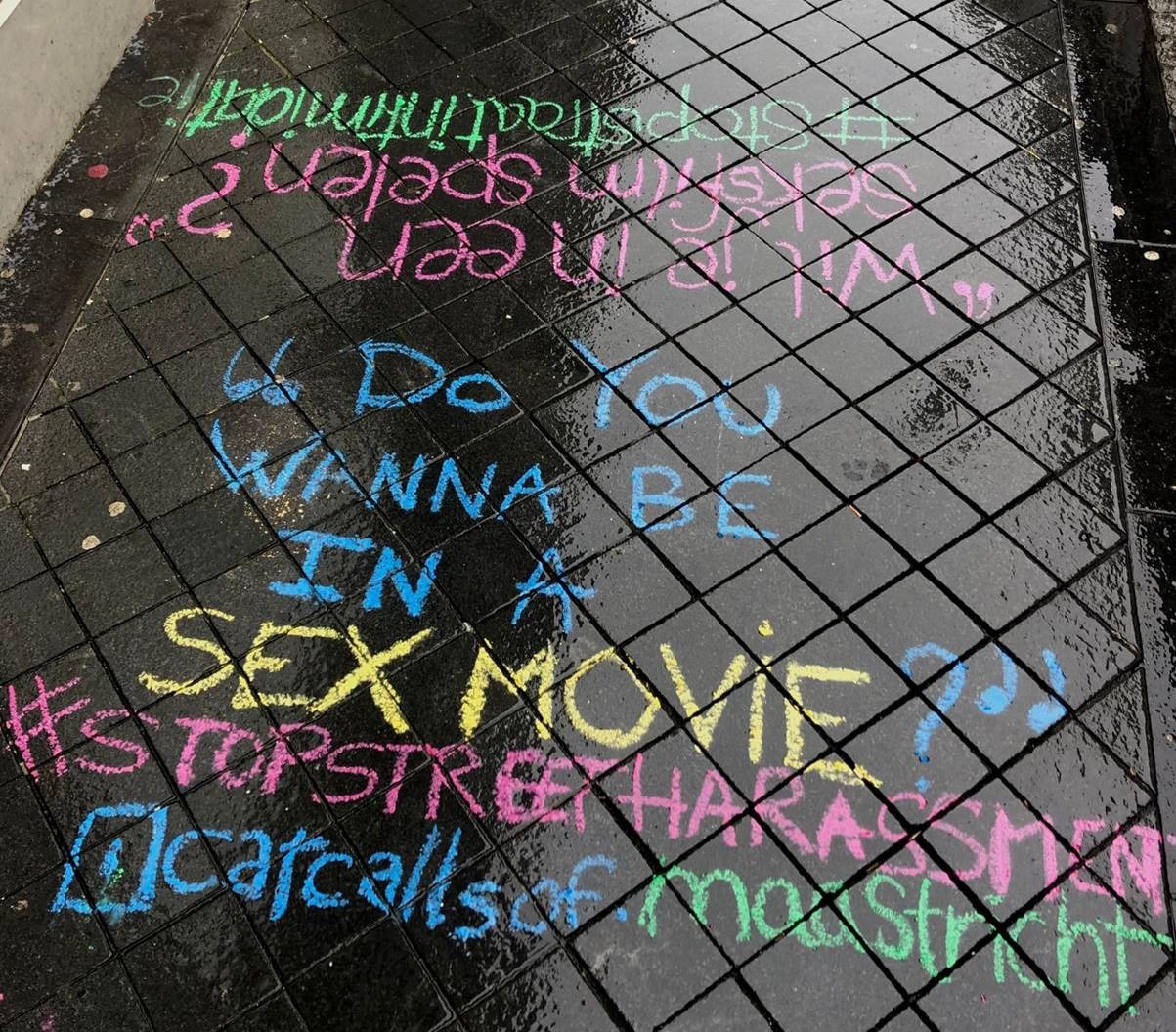
ChalkBack responds directly to this issue. Founded in 2016, the movement encourages people to “chalk back”: activists chalk the words that people were harassed with at the exact location where the harassment occurred. The chalked message is then photographed and shared on Instagram. This practice does two things at once: it reclaims the street as a place where those harmed are visible and heard, and it creates a transnational community connected through digital platforms. What once felt like an isolating incident becomes part of a collective narrative of resistance.
Unlike large protests that temporarily gather crowds, ChalkBack’s intervention is small-scale and embedded into the everyday urban environment. A sidewalk, bus stop, alleyway or school entrance becomes a site of civic action (see CatcallsofBerlin or Catcallsofnyc). This locational specificity matters: it asserts that everyday places, often understood as neutral, are sites where individual liberties are harmed and power is negotiated. By marking these spaces, activists transform them into civic spaces. They become places where political meaning is formed and awareness is raised through presence and visibility.
Chalking Civic Spaces
Civic space can be understood as the arena in which people participate in public life, express grievances and claim rights. ChalkBack amplifies this idea: chalk, a simple and temporary medium, demonstrates that civic participation does not require formal authority. The act of writing on the street is a performance of citizenship: it asserts that one belongs here, that one’s voice matters, and that public space is supposed to be shared.
Social media amplifies this spatial intervention. Platforms like Instagram function as additional civic arenas where people circulate stories, express support and form networks. The digital sphere does not replace the street but mirrors and extends it. ChalkBack operates in two interconnected publics: the physical street, where harassment occurred, and the digital public, where experiences are collectively recognized. It is precisely this dual spatial practice that allows the movement to channel individual experiences into collective awareness.
Civic Spaces as Capacities for Care
ChalkBack is also notable for its emphasis on empowerment and care. Most activists are young and identify as FLINTA*. Many have encountered (sexual) harassment in their adolescence. Through the movement, they learn that their experiences are not isolated and that resistance can be enacted creatively. The collaborative nature of chalking, sharing and responding to messages creates forms of solidarity that are themselves civic: they build relationships grounded in mutual recognition and responsibility for others.
The civic spaces created by ChalkBack are therefore not only physical, but also emotional and relational. They cultivate belonging in environments where many have felt excluded or threatened. This is a fundamentally democratic act. When more people feel entitled to speak and move freely in public, public space becomes more inclusive; when voices previously silenced become part of public dialogue, civic space expands.
“Individual self-empowerment should not be at the center of feminist fights, but it is always a question of caring: Who identifies as a feminist needs to take into account how others are feeling and how one’s actions influence others.” (Bücker, 2022, p.128)
In times where civic spaces are increasingly threatened, ChalkBack opens a door for action, on the local as well as the global level. It brings together victims, activists and bypassers in a body of shared awareness that can serve as a momentum for social change which transcends beyond the local sphere into a collective call for action. ChalkBack shows that reclaiming space can be a powerful and accessible form of participation. It transforms everyday environments into arenas of accountability and shared presence, reminding us that public space is not simply a given, but something continuously recreated, and that those who use it have the right and power to shape it.
Marlene Wulf joined Polis180 in early 2025. She holds two master’s degrees in International Relations and War and Conflict Studies. Her focus includes EU foreign policy, conflict resolution, promoting democracy and stability, as well as journalism. Marlene has worked with both governmental and non-governmental organisations and is involved in projects on historical memory, reconciliation, and the inclusion of displaced populations.
- This article refers to persons who identify as females, lesbians, intersexual, nonbinary, trans, asexual, and who are overproportionally affected by catcalling as FLINTA*. ↩︎
Previously from the blog series “Shrinking Spaces – Creating Spaces”
The Polis Blog serves as a platform at the disposal of ‘Polis180’s & ‘OpenTTN‘s members. Published comments express solely the ‘authors’ opinions and shall not be confounded with the opinions of the editors or of Polis180.
Back